
Ripley County Probate Division
Missouri probate is handled as a division or case type within the Circuit Court. Ripley County does not have a separate county probate court building. Probate venue is the Probate Division of the Ripley County Circuit Court at the courthouse, and the Circuit Clerk is the access point for probate filings, docket questions, certified probate copies, and case files not available through Case.net. The Missouri Association of Counties Ripley directory lists the courthouse circuit clerk contact.
The probate division handles decedent estates, wills, letters testamentary, letters of administration, small estates, guardianships, conservatorships, minor estates, incapacitated adult matters, trust registrations, will contests, creditor claims, inventories, accountings, and settlement or discharge orders. Some probate records are public, but guardianship, mental-health, minor, adoption, and sensitive medical or financial material may be restricted.
Probate Division of Circuit Court
Ripley County Courthouse
100 Court House Sq
Doniphan, MO 63935
573-996-2818
Circuit Clerk probate access channel
Ripley County Probate Terms
Probate records use terms that can be hard to read if the case is a first estate or guardianship matter. These plain definitions help identify who is involved and what the court order may be doing.
- Testator
- A person who made a will.
- Executor
- A person named to carry out the will after court authority is granted.
- Intestate
- Dying without a valid will, so estate distribution follows Missouri law.
- Personal representative
- The fiduciary appointed to administer an estate.
- Guardianship
- A court case about personal care decisions for a minor or incapacitated person.
- Conservatorship
- A court case about managing money or property for a protected person.
Search Ripley County Probate Records
Case.net is the online starting point for public Ripley County probate cases. Search by decedent name, ward or protectee name if public, case number, or filing date. If a probate case is old, paper-only, sealed, confidential, or not easy to locate, contact the Circuit Clerk directly. The Ripley County local government phone list also confirms the local circuit court and circuit clerk phone channels. Certified probate copies, letters, authenticated copies, and full file review require clerk processing.
- Open Missouri Case.net from the Missouri Courts site.
- Search by case number if known, or search by the decedent, ward, protectee, petitioner, or representative name.
- Use Ripley County or the 36th Judicial Circuit as a filter when the portal offers one.
- Review the case type, filing date, parties, docket entries, letters, orders, and public documents if available.
- Call the Circuit Clerk for certified copies, missing documents, older records, sealed-file questions, or probate filings.
Probate may also connect to land records. The Recorder of Deeds may hold recorded deeds or other instruments related to estate property, but that office does not administer probate cases.
Ripley County Small Estates
Missouri section 473.097 governs the small-estate affidavit procedure. The research file notes Missouri Courts small-estate packet examples with affidavits for collection of small estate, will and intestate variants, bond or corporate surety forms where applicable, filing information sheets, and estate notices. Local Ripley packet and fee details were not located.
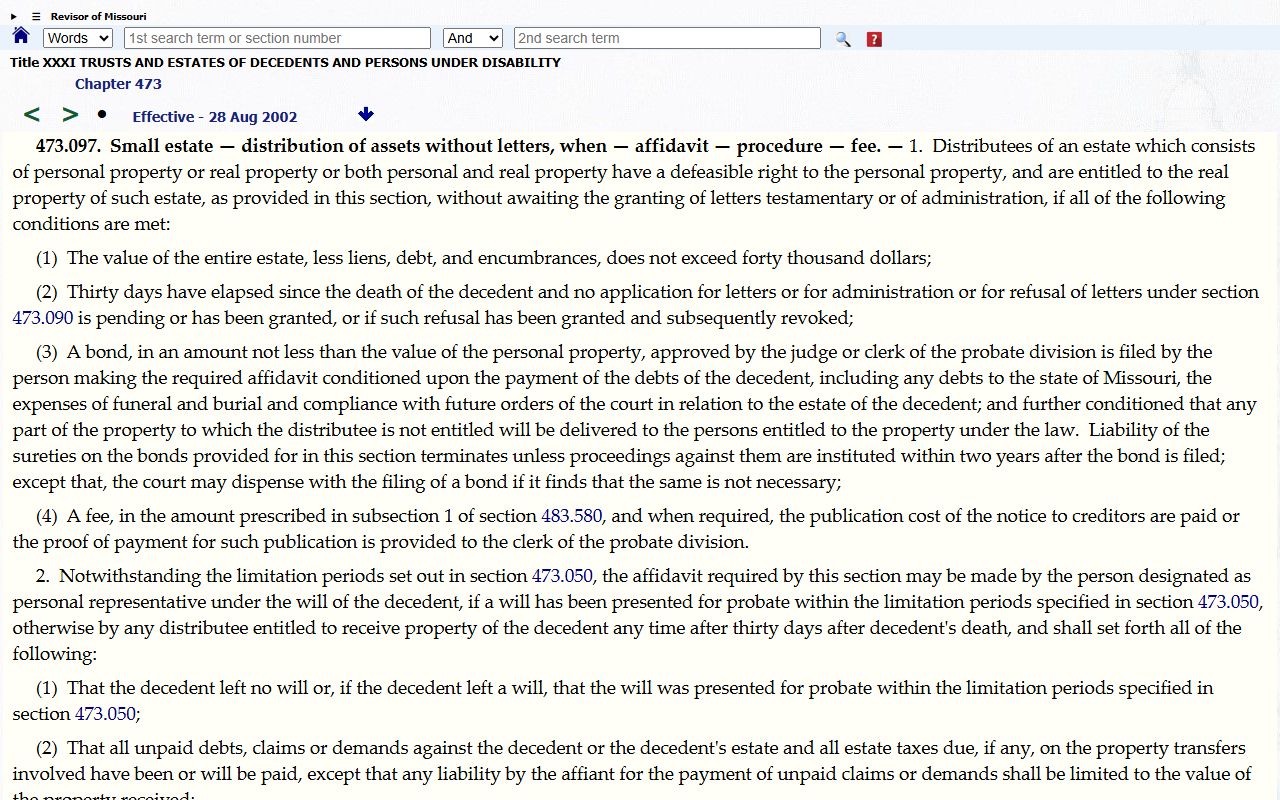
The small-estate process is still a court filing. The Circuit Clerk should confirm current filing requirements, local form availability, and the filing deposit before a person submits papers.
A small-estate affidavit is typically used after a waiting period following death and requires sworn or notarized facts about the decedent, heirs or distributees, assets, debts, and whether a will exists. The court may require notices, bond, or other documents depending on the estate and the statute.
How Ripley County Probate Moves
A probate matter usually begins with a petition, affidavit, or application filed in the Probate Division of Circuit Court. The filing may ask the court to admit a will, appoint a personal representative, issue letters, open a small estate, appoint a guardian, or appoint a conservator. The clerk receives the filing, collects the required deposit if one applies, and routes the matter through the court process.
The basic flow is: filing with the Circuit Clerk, court review, letters or orders if statutory requirements are met, notices to heirs or creditors when required, inventory and claim activity, accounting or settlement, distribution, and final discharge. That flow can change for guardianship, conservatorship, contested wills, creditor objections, or cases with missing heirs. Older or complex probate files may require in-person clerk help because the public Case.net view may not show every document.
Ripley County Probate Fees
A local Ripley County probate fee schedule was not located in the official sources inspected. Another Missouri circuit's probate packet should not be used as a Ripley fee source. Before filing an estate, guardianship, conservatorship, or small-estate affidavit, call the Circuit Clerk to confirm the filing deposit, copy charges, certification cost, accepted payment methods, and any publication or bond cost that may be separate from clerk fees.
| Probate Item | Amount / Local Status |
|---|---|
| Decedent estate filing deposit | Not located in official Ripley sources; verify with Circuit Clerk. |
| Small-estate affidavit filing | Not located in official Ripley sources; verify with Circuit Clerk. |
| Guardianship or conservatorship filing | Not located in official Ripley sources; verify with Circuit Clerk. |
| Letters testamentary or administration copies | Not located in official Ripley sources; verify with Circuit Clerk. |
| Certified probate copy | Not located in official Ripley sources; verify with Circuit Clerk. |
Ripley County Probate Record Fields
Probate files can be document-heavy. A public case summary may show only basic case information, while the clerk file may contain petitions, affidavits, letters, inventories, accountings, notices, claims, orders, and final settlement papers. Some documents may be redacted or closed due to personal identifiers, minor information, medical facts, or protected financial data.
| Field / Document | What It Shows |
|---|---|
| Case number | Probate case identifier. |
| Decedent / ward / protectee | Name of the person whose estate or guardianship is involved. |
| Filing date | Date the estate or guardianship opened. |
| Personal representative / guardian / conservator | Person appointed by court. |
| Attorney | Counsel for the estate or fiduciary if any. |
| Will filed / admitted | Whether a will was presented or admitted. |
| Letters issued | Authority granted to the representative. |
| Inventory | Assets and values, sometimes with sensitive information. |
| Claims and accountings | Creditor claims, objections, fiduciary financial reports, and settlements. |
| Orders | Appointment, bond, sale authority, final settlement, discharge, or other rulings. |
Restricted Ripley County Probate
Public access to probate records is not the same for every case type. Many decedent-estate dockets are open, but guardianship, conservatorship, mental-health, minor, and sensitive financial or medical filings may be limited. Personal identifiers, account numbers, confidential addresses, and minor information may be redacted even when the case itself is public.
Adoption is not a public probate lookup category. Section 453.120, RSMo limits adoption record inspection except by court order. That rule should be treated as a boundary when a family-history or probate question overlaps with an adoption file.
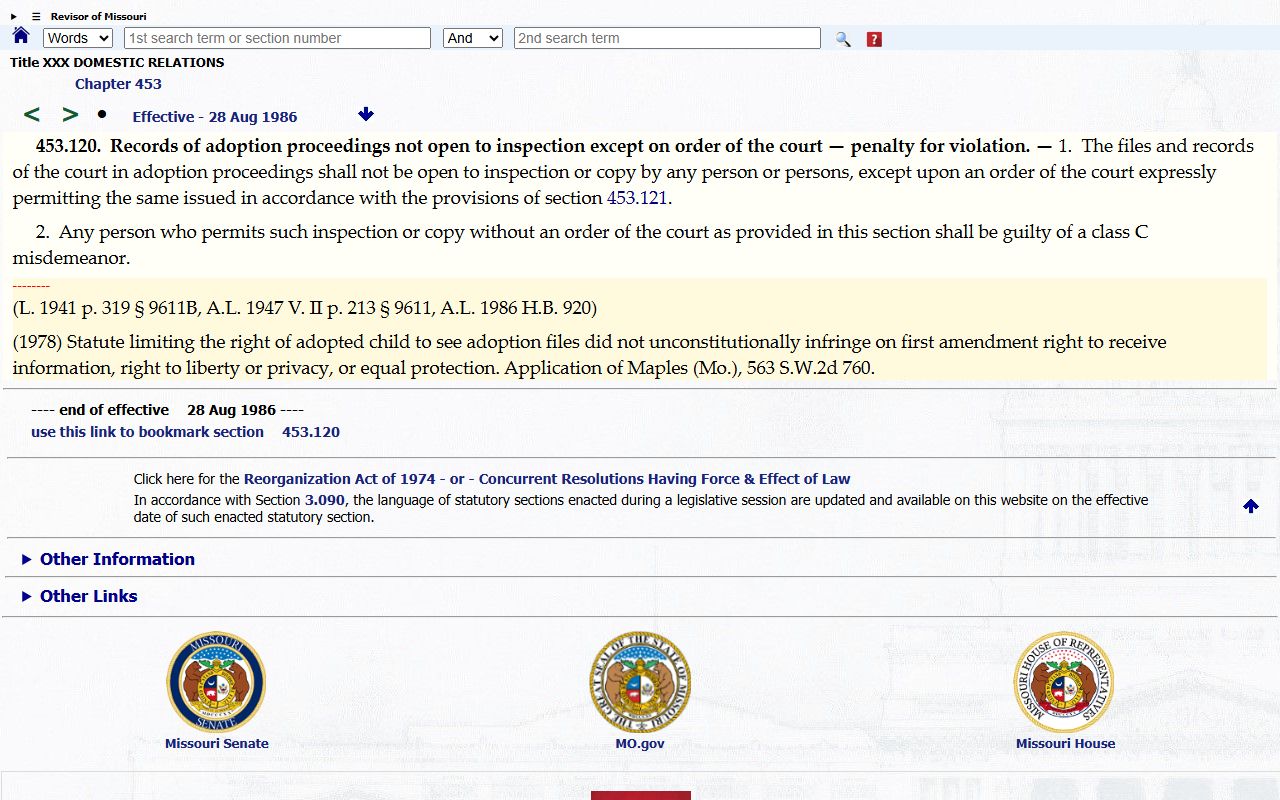
The adoption statute is a useful reminder that a case may involve family history and still be closed to ordinary public inspection.
Missouri Court Operating Rule 2 governs access to judicial department records. County administrative records may fall under Sunshine Law, but probate case files remain court records. When Case.net does not show a document, the practical next step is to ask the Circuit Clerk whether the record is public, restricted, sealed, or available only by in-person file review.